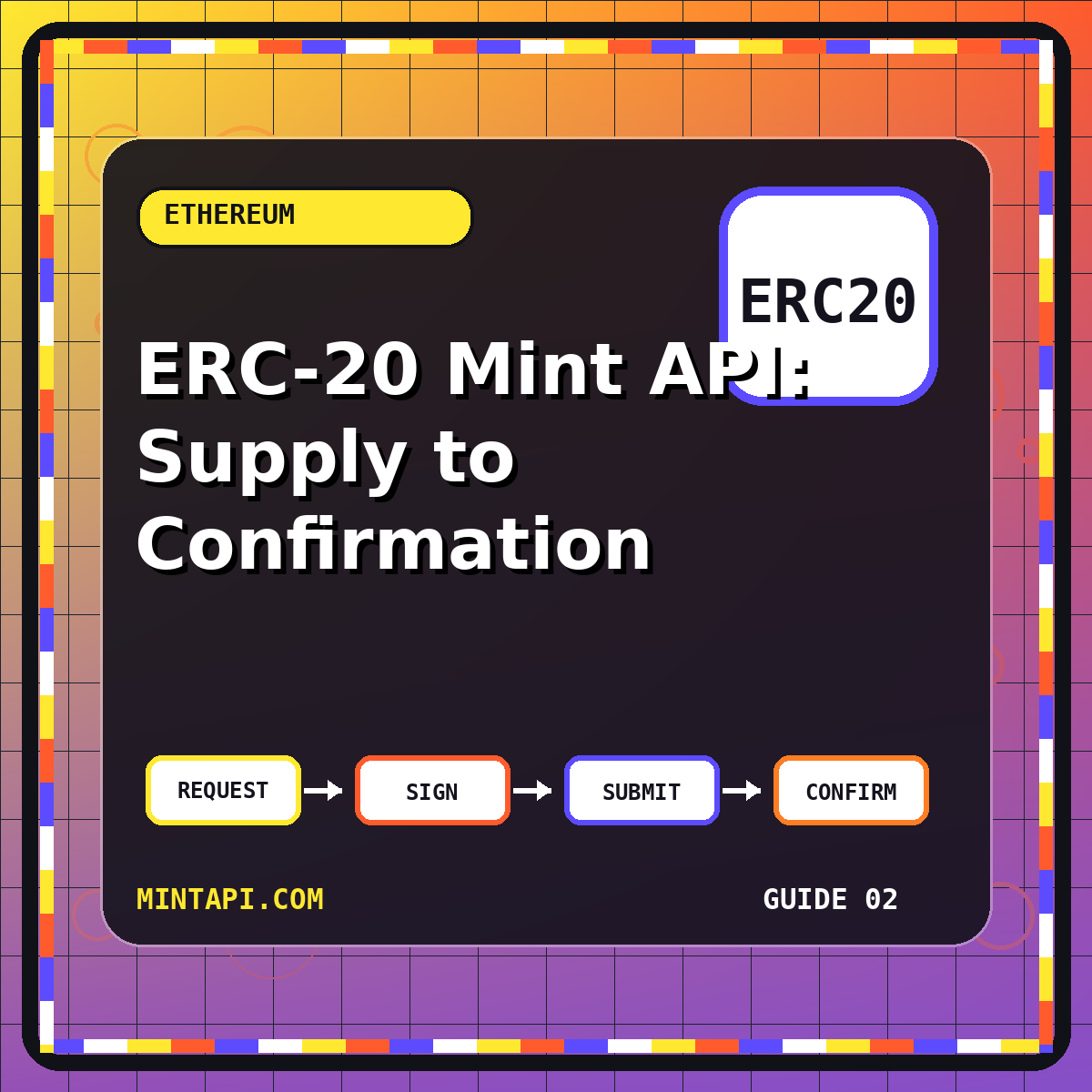
An ERC-20 mint API exposes a controlled application workflow for calling a token contract's authorized supply-creation function. The API does not make an arbitrary ERC-20 mintable. Minting is possible only when the deployed contract includes a supply mechanism and the transaction is authorized by the role, owner, multisignature account, or governance process defined by that contract.
The safest design begins with the contract rather than the endpoint. Document the exact function that changes supply, the entity permitted to call it, the maximum or policy-controlled amount, pause behavior, decimals, supported networks, and events emitted. The HTTP layer can then validate requests and coordinate transactions without inventing rules that conflict with on-chain code.
Understand the contract's supply model first
Some contracts create a fixed supply in the constructor and expose no future mint function. Others allow a privileged address to call a public wrapper around an internal mint operation. A capped token can mint only until a maximum supply is reached. A role-based token may grant and revoke a minter role. Upgradeable contracts add another governance surface because the implementation itself may change. The API inventory should record which model applies to every asset.
Do not infer mintability merely because a contract reports the ERC-20 interface. The standard defines common balance, transfer, approval, allowance, and supply behavior; it does not require an externally callable mint method. Before enabling an asset, inspect verified source or deployment artifacts, confirm the deployed bytecode and proxy relationships, identify the authority, and test the exact call on the target network.
Represent amounts as integers, not floating-point values
ERC-20 balances are stored as integer base units. The display value is derived using the contract's decimals setting. If a token uses six decimals, a display amount of 1.25 corresponds to 1,250,000 base units. The API should either accept a decimal string and convert it with an exact decimal library or require the raw integer explicitly. It should never use binary floating-point arithmetic for monetary conversion.
A strong request schema can include both amount as a string and amount_unit as either display or base. The service resolves decimals from the registered asset configuration, converts once, and stores the raw integer in the operation record. Returning both representations helps clients display values while preserving the exact number sent to the contract.
Validate the recipient and asset context
Address syntax checks are necessary but insufficient. Confirm that the request targets the registered chain ID and contract address, that the asset is enabled, that minting is not paused by application policy, and that the recipient is allowed under any distribution rules. For contracts with allowlists, sanctions controls, transfer restrictions, or account freezing, determine whether those constraints apply at mint time or only later.
Avoid silently rewriting a recipient or selecting a default chain when the request is ambiguous. The operation record should contain the checksummed or normalized address used for transaction construction, the chain ID, contract address, function signature, and asset version. These fields provide a precise audit trail and prevent a configuration change from altering an already accepted operation.
Construct the contract call deterministically
The transaction builder should use an allowlisted ABI and method selector associated with the asset, not method names supplied by the client. Common mint wrappers accept a recipient and amount, but real contracts vary. Some include a reason code, batch recipients, signed authorization, or a token cap check. Encode arguments from the normalized operation and verify that the destination contract, chain ID, value, and calldata match the policy before signing.
Gas configuration should be explicit. Estimate gas against a recent block, apply a bounded safety factor, and choose fee parameters through a network policy rather than arbitrary client input. If simulation indicates a revert, classify the reason before signing when possible. A cap failure, paused contract, missing role, invalid recipient, and transient RPC problem should not all become the same generic error.
Protect the minter authority
The account that can create supply is one of the most sensitive assets in the system. A production design often places authority behind a multisignature, a hardware-backed signer, a managed key service, or a contract-based access-control mechanism. The API worker should request a narrowly defined signature and should not export or directly read the private key. Separate the public request service from the signing service and record every authorization decision.
Limits should exist at several layers. The contract may enforce a cap or role, the signer can enforce per-transaction and cumulative limits, and the API can enforce customer, asset, or campaign limits. Layering does not replace the contract's guarantees, but it reduces the chance that one application bug or credential compromise can immediately produce an unbounded supply change.
Handle nonces, replacements, and ambiguous submission
Transactions from one EVM account share a nonce sequence. Concurrent workers must coordinate nonce allocation or use a signing component that owns that responsibility. If two jobs sign different transactions with the same nonce, only one can be accepted. If a transaction remains pending, a replacement uses the same nonce and higher fees; it is not a new mint operation. The operation record should link every replacement hash to the same logical request.
A timeout after broadcast does not prove the transaction failed. Query the transaction hash and account nonce before constructing anything new. If the signed raw transaction is retained securely, rebroadcasting the exact same bytes is safe because it represents the same transaction. Creating a new transaction with a new nonce for the same business request can mint twice and should happen only after reconciliation proves the original cannot execute.
Confirm the event and reconcile balances
An ERC-20 mint typically emits a Transfer event from the zero address to the recipient, but the API should use the actual contract behavior configured for the asset. Confirmation processing can verify the transaction receipt status, contract address, expected event signature, recipient, and amount. It should also record block number and block hash so later monitoring can detect a reorganization affecting the receipt.
Reconciliation goes beyond receipt success. Read total supply and, when practical, the recipient balance at a defined block context, then compare the observed delta with the operation. If other activity makes a simple balance delta ambiguous, the event and transaction trace remain important evidence. A mismatch should produce a review state and alert rather than an automatic retry.
Make errors actionable for API clients
Clients need stable machine codes such as asset_not_mintable, amount_out_of_range, authority_denied, contract_paused, simulation_reverted, rpc_unavailable, and confirmation_timeout. Pair the code with a safe human message, request ID, and retry guidance. Do not expose raw provider errors that leak internal endpoints or force clients to parse node-specific text.
Separate request errors from operation failures. A malformed address can be rejected synchronously with a 4xx response. A transaction that later reverts belongs to the accepted operation and should be visible through its status resource and webhook. This distinction lets the client know whether it must correct the request, wait, or escalate.
Test invariants, not only happy-path transactions
Contract tests should prove that unauthorized accounts cannot mint, caps are enforced, paused behavior is correct, decimals are interpreted consistently, and expected events are emitted. API tests should add duplicate idempotency keys, concurrent requests, RPC timeouts, replaced transactions, receipt reorgs, signer denial, and reconciliation mismatches. Use a local chain for deterministic tests and a public test environment for infrastructure behavior.
Before mainnet enablement, pin the contract address and chain ID in reviewed configuration, verify role membership from the deployed contract, run a small end-to-end issuance to a controlled address, and confirm the explorer, indexer, and internal ledger agree. Production readiness is a chain of evidence, not a successful unit test or a single transaction hash.
Primary standard or official reference
OpenZeppelin: Creating ERC-20 Supply. OpenZeppelin's guide explains that ERC-20 supply creation is an implementation choice built around the internal minting mechanism; an API must respect the roles and invariants chosen by that contract.
Conclusion
An ERC-20 mint API should make an authorized contract operation easier to consume without weakening its controls. Exact integer math, deterministic calldata, isolated signing, coordinated nonces, idempotent operations, receipt verification, and balance reconciliation are the essential pieces. The contract remains the final authority over supply, while the API provides policy, reliability, and evidence.
Treat every token as a configured asset with its own contract facts. A universal endpoint can still be useful, but only when it resolves to a verified chain ID, contract, ABI, supply model, authority, and confirmation policy before a transaction is signed.