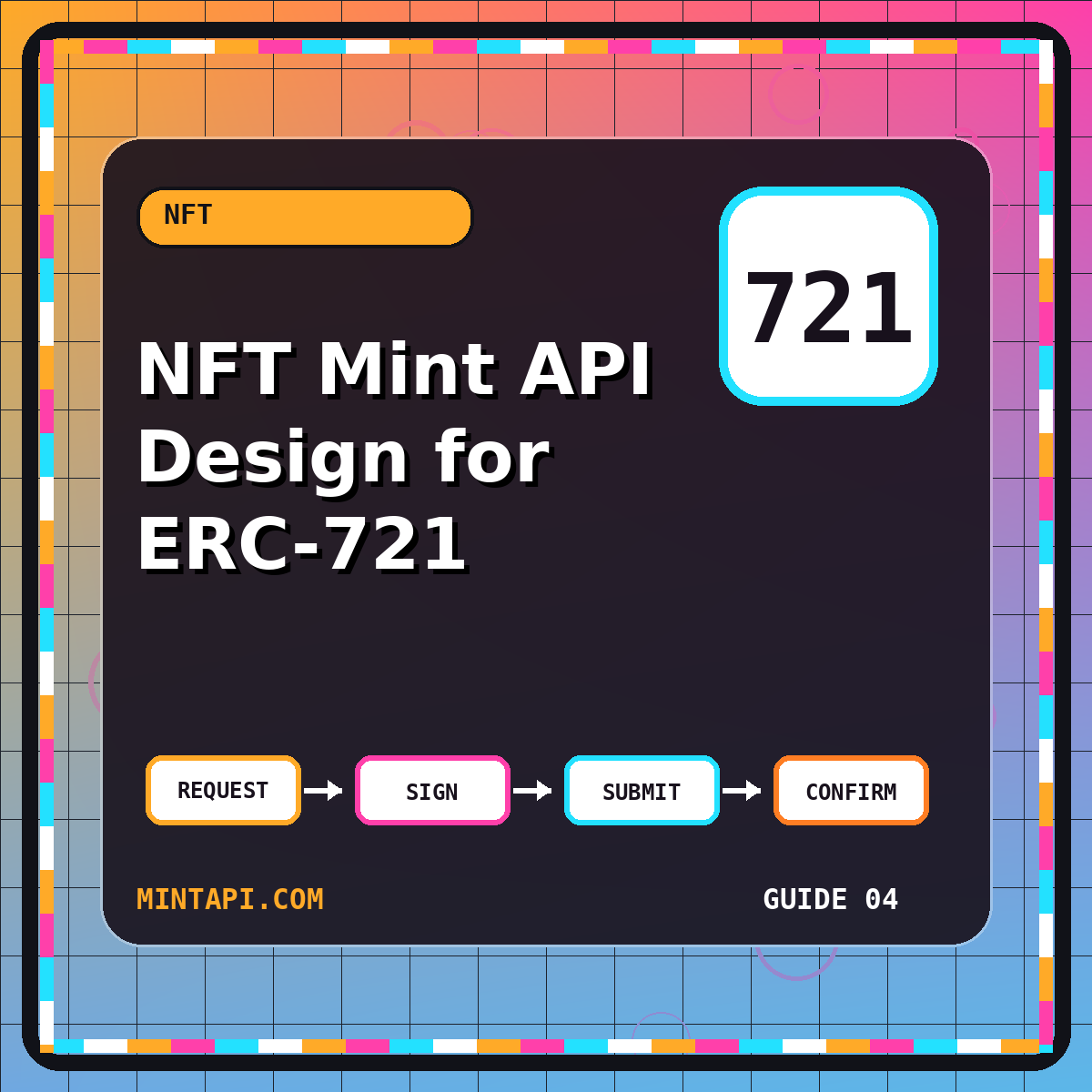
An NFT mint API coordinates the creation and assignment of a unique token. The visible result may be a collectible in a wallet, but the production workflow spans more than a contract call. It can include metadata validation, media processing, storage publication, token ID allocation, contract authorization, transaction submission, ownership confirmation, indexing, and webhook delivery to the application that requested the mint.
The API should preserve the distinction between the token, its metadata, and its media. The blockchain records ownership and a token-specific identifier, while the contract may expose a URI that points to a metadata document, which in turn references images or other files. A reliable service treats each layer as an explicit artifact with its own integrity and lifecycle.
Define what makes the asset unique
Before designing endpoints, define the collection's uniqueness rule. A token can be unique because its token ID maps to a one-of-one artwork, a serial-numbered physical item, a membership credential, a ticket, or a record in another system. The API should accept or derive a stable external reference so the same business asset cannot be minted twice through separate requests.
Use a uniqueness constraint in the application ledger in addition to an idempotency key. Idempotency prevents one request from being repeated; an external asset key prevents two differently keyed requests from representing the same underlying item. The operation should record the collection, external reference, recipient, metadata version, and resulting token ID.
Create metadata before committing ownership
A common workflow validates metadata and publishes its referenced media before submitting the mint transaction. This avoids creating a token whose URI points to missing or rejected content. Validate required fields, data types, URL schemes, media dimensions, file sizes, content types, and collection-specific attributes. Normalize the document into a deterministic representation and store a content hash with the operation.
The API should state whether metadata is immutable, replaceable by an authorized editor, or generated dynamically. Immutability can improve provenance but makes mistakes permanent. Mutable metadata supports corrections and evolving assets but introduces an authority that must be protected and disclosed. The choice belongs to the product and contract design, not to an undocumented storage default.
Allocate token IDs with the contract model in mind
Some contracts increment token IDs internally, while others accept an explicit ID. Sequential IDs are simple, but the API cannot assume the next value until the transaction executes. Explicit IDs can encode an external identifier or be randomly assigned, but they need uniqueness checks at both application and contract layers. Concurrent workers must not race to use the same ID.
When the contract assigns the ID, parse the emitted event or return data and bind the observed token ID to the operation. When the caller proposes an ID, validate its range and collection policy, reserve it durably, and release or mark it carefully after failure. Never infer the minted ID from a local counter without confirming the transaction.
Keep contract authorization narrow
The minting function may be restricted to an owner, role, signed voucher, multisignature account, or sale contract. The API must match that mechanism exactly. A role-based backend can ask a protected signer to call the contract. A voucher model may let a recipient or marketplace submit a signed authorization. A public sale can enforce payment and limits on-chain while the API prepares inputs and tracks outcomes.
Do not make the backend's hot key the permanent collection administrator merely for convenience. Separate minting, metadata, pause, upgrade, and withdrawal privileges when the contract supports it. Put high-impact roles behind stronger governance and let the API use only the authority required for the normal issuance path.
Treat media and metadata publication as a state machine
Uploads can fail, content-addressed storage can take time to propagate, and moderation or rights review can be asynchronous. Model states such as draft, validating, published, mint_submitted, and delivered. Only a published metadata version should be eligible for minting. If publication is reversible, record the exact URI and hash used for each token.
A separate metadata resource also enables reuse. Multiple editions may share media but have distinct token-level attributes, or a collection may use a base schema with item overrides. The mint request can reference an immutable metadata-version ID instead of sending an arbitrary document that is difficult to reproduce later.
Make the mint operation retry-safe
NFT duplication is especially visible because each token is expected to be unique. Require an idempotency key and bind it to the collection, recipient, external asset key, metadata version, and requested token ID when applicable. A retry must return the same operation and eventual token, not create another edition.
After a submission timeout, query the transaction hash and contract events before constructing a new transaction. If the token ID was explicit, check current ownership as part of reconciliation. If the contract assigned the ID, search the known transaction and collection events using the operation's submission evidence. Ambiguity should stop automatic reminting.
Verify ownership and token URI after confirmation
A successful receipt is necessary but the service should verify the expected ownership event, collection contract, recipient, and token ID. Read ownerOf at a suitable block context and resolve the token URI when the contract exposes it. Compare the observed URI or metadata hash with the published version linked to the operation.
Indexers and marketplaces may display the token later than the chain confirms it. The API should separate blockchain delivery from third-party indexing and avoid claiming marketplace visibility as part of confirmation. It can expose an indexing status as optional, provider-specific telemetry without making it the source of truth for ownership.
Design batch minting as coordinated child operations
A batch endpoint is useful for campaigns and collections, but a batch is not automatically atomic. One contract call may mint several tokens in a single transaction, while a large job may require many transactions. Represent the batch as a parent with child item operations and define whether a partial result is allowed. Each item still needs an external asset key, metadata version, recipient, and final token ID.
Backpressure and quotas protect the signer, RPC provider, storage system, and collection policy. Validate the full batch before scheduling when all-or-nothing business semantics are expected. If the chain cannot provide that atomicity, say so clearly and supply a reconciliation report that lists confirmed, failed, pending, and review-required items.
Return provenance evidence, not just an explorer URL
A durable response should include the collection contract, chain ID, token ID, owner, transaction hash, block reference, token URI, metadata hash, media hashes when available, and the internal external-asset reference. An explorer URL can be convenient, but it is a presentation link rather than the evidence itself and may vary by network.
Preserve the normalized metadata document and publication receipt according to the product's retention policy. If metadata is mutable, maintain a version history and record which authority approved each change. This evidence helps support teams answer whether the right asset was minted, whether content changed, and which system or actor initiated the action.
Define a delivery contract for downstream applications
Document which event or status tells a downstream application that it may display, fulfill, or transfer the asset. Include the collection, token ID, owner, metadata version, transaction evidence, and confirmation meaning in that delivery contract. When indexing or media availability lags, publish separate fields rather than delaying or overstating blockchain ownership. This prevents commerce, ticketing, or game systems from treating a marketplace cache as the authoritative source of delivery.
Primary standard or official reference
ERC-721 Non-Fungible Token Standard. ERC-721 defines the ownership and transfer interface for non-fungible tokens; metadata creation, storage, authorization, retries, and delivery remain application and contract design responsibilities.
Conclusion
A dependable NFT mint API coordinates uniqueness, content, authority, transaction execution, and ownership evidence. It should publish a validated metadata version, create a durable operation, prevent duplicate business assets, submit through a restricted minting path, confirm the expected token event, verify ownership and URI, and report third-party indexing separately.
The design is strongest when the API makes every artifact explicit: collection, external asset key, metadata version, token ID, owner, transaction, and confirmation policy. That structure supports one-off collectibles, large campaigns, and tokenized physical items without reducing the workflow to an unsafe 'mint now' button.